

I pray that you found Part 1 encouraging and thought provoking. Please remember that I am sharing how I endeavour to rightly divide the word of truth.
When I am studying a portion of scripture I employ all these principles to try to understand the Father’s will more perfectly.
Enjoy 😊
3. We simply read what is written in the scriptures.
2 Timothy 3 v 16 and 17
“All scripture is given by inspiration of God, and is profitable for doctrine, reproof and correction: for instruction in righteousness.
That the man(woman) of God may be perfect, throughly furnished unto all good works.”
I could ask 10 people to read verse 16 out loud; I guarantee that 9 or even 10 out of 10 will read the word “thoroughly” instead of “throughly.”
As I write “Spell check” is changing “throughly” to “thoroughly.” Our minds can sometimes be like “Spell check”: At times we lazily read the scriptures and we don’t focus on each individual word. You may ask “What difference does it make?” Well, the scripture reads “throughly furnished.”
Perfect implies a complete, internal, spiritual perfection: simply received by grace; whereas “thoroughly” would indicate a perfection that is external: achieved by our own works.
We can wash our hands “thoroughly,” but not “throughly.” “throughly” is rightly dividing the word of truth; “thoroughly”, is not.
To illustrate this point further: the Greek word for ” throughly furnished” is “exartizo” and was used when a ship was about to set sail and was perfectly equipped for it’s voyage in every detail.
We must, simply and meticulously, read ALL the words in the scriptures that we are studying.
When we scrutinize a legal document we examine every word minutely. For example, a Will that we have been mentioned in, as beneficiaries. We read and re-read every sentence that applies to us. Why?
To ensure that we receive everything that was promised to us in that legal document. When there is money or property involved, we examine the will “throughly” i.e. in detail, forensically, from every possible angle, rather than a ” thoroughly” cursory reading.
Can I encourage you to apply the same principle when studying the scriptures: the word and will of God.
Let us observe another example of this from scripture.
Acts 9 verses 3 and 4
“And as he(Paul) journeyed, he came near Damascus: and suddenly there shined round about him a light from heaven:
And he fell to the earth, and heard a voice saying unto him, Saul, Saul, why persecutest thou me?”
These scriptures concern the “Conversion of Paul” on the road to Damascus. To rightly divide them, let us simply read them as written. No problem. Very simple to understand.
Unfortunately, almost every preacher, that I have heard share on these verses, has insisted on adding the words “from his horse” immediately after the words ” .. And he fell..” in verse 4.

There is no horse mentioned in these verses; any suggestion that Paul fell from a horse is unscriptural and private interpretation. This private interpretation was first disseminated in the Protestant church by John Calvin, the reformer, in 1550. It began to be highlighted again in evangelical mega ministries in the 1960’s and 1970’s in America, to the point that most preachers there today add these words to scripture without a second thought.
We must be vigilant: if we add our own words to scripture or delete words from scripture: we no longer have the word of truth.
Satan realizes this fact. In his dealings with Adam and Eve, in the book of Genesis, he constantly misquoted (by addition and deletion) the words that our Heavenly Father spoke to them regarding the tree of life. Their decision to believe those misquoted scriptures produced cataclysmic consequences.
Please contrast those circumstances with the temptation of our Lord Jesus in the desert, after He had received the Holy Spirit. Each temptation was accompanied by misquoted scriptures; yet He brushed them aside, stating “It is written” quoting the appropriate rightly divided word of truth. We, like Him, must do likewise.
What other doctrines are we being taught by our pastors and teachers, that are unscriptural and are full of private interpretation? The only way to find out is to rightly divide the scriptures in these doctrines ourselves.
It is interesting to note that the Roman Catholic Church has always expounded that Paul fell from a horse, as witnessed by paintings commissioned and paid for by the Vatican. Michelangelo’s painting “the conversion of Paul” located in the Pauline chapel in Vatican city, painted in 1542, depicts Paul fallen from a horse.
Caravaggio’s oil painting “the conversion of Paul” painted in 1600, located in the Cerasi chapel in Rome: likewise These are but two of the many paintings funded by the Roman Catholic Church: all depict Paul fallen from a horse.
However, when you Google these paintings, you are informed that there is no scriptural basis to verify that Paul fell from a horse; merely that the horse was added “for effect.”
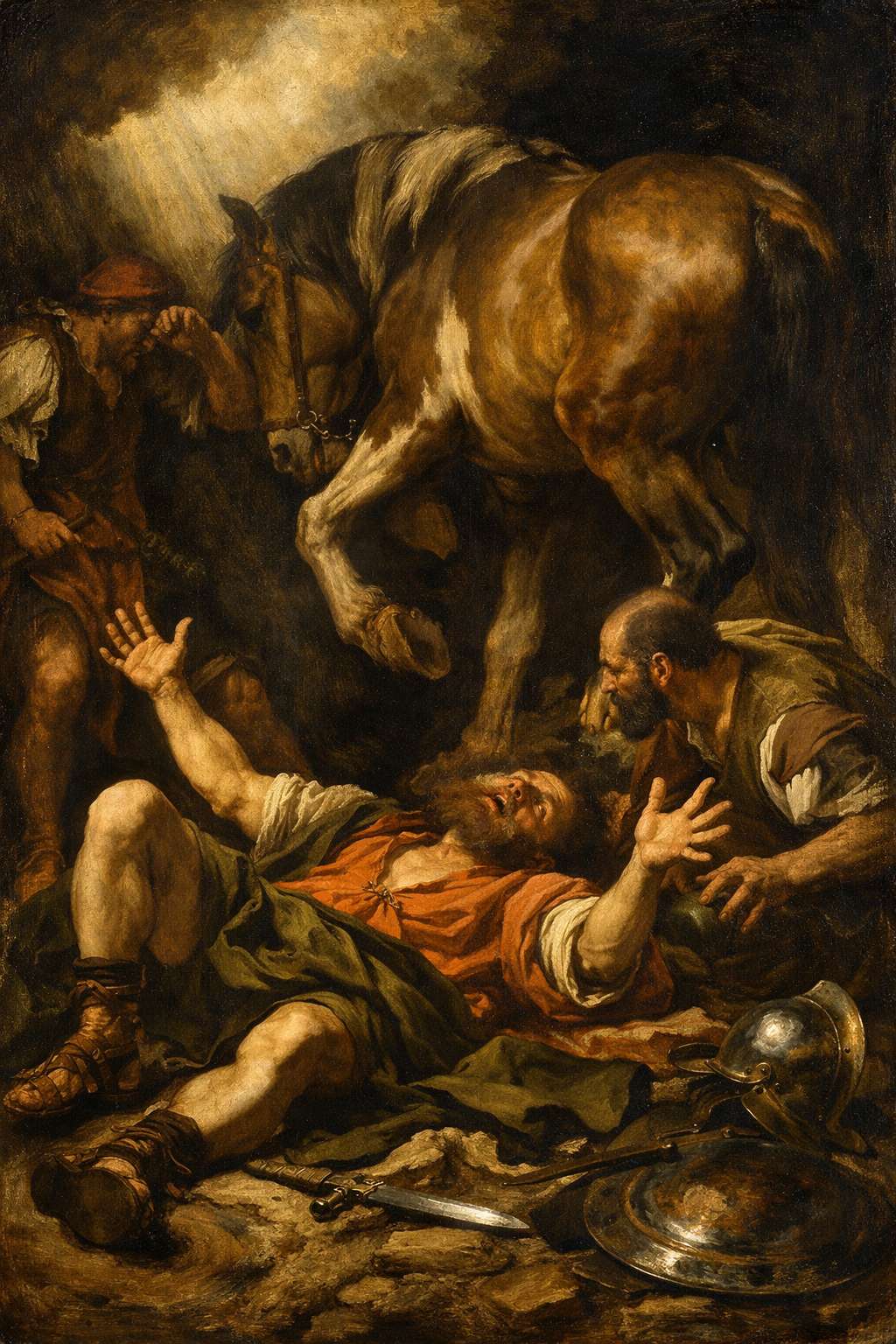
A pastor I know who constantly mentioned Paul’s horse in teachings proudly produced these two paintings on his smart phone to me as proof that Paul fell from a horse.
Need I say more?
If we are patient and genuinely seeking the truth, the Holy Spirit will bring clarity to any apparent confusion regarding the scriptures.
ALL is revealed as we read on:
Acts 9 v 8
“And Saul arose from the earth; and when his eyes were opened, he saw no man: BUT THEY LED HIM BY THE HAND, and brought him into Damascus.”
They led him by the hand, and brought him there. They walked. No horse!
In conclusion:
In the times we live in, the integrity and veracity of God’s holy scriptures are constantly being questioned by the “Arts” by social media, by online podcasts, by content produced by using A.I. and, unfortunately, by individuals in the church who fail to rightly divide the scriptures, and consequently, continue to teach traditional doctrines even though they are scripturally unsound.
In light of this onslaught, what are we to do?
We are to simply follow the example of our Lord Jesus and proclaim “It is written” and speak out the rightly divided word of truth, when we are confronted with error.
To be able to proclaim “It is written” we must know and rightly divide the scriptures.
To know and rightly divide the scriptures
we are to simply read the scriptures as written in the Bible, with nothing added and nothing taken away.
That concludes Part 2.
Part 3 will be published in a couple of weeks.
Blessings.